Field report NE-8 / R2 · sheet /operations
Operations & RestructuringFiled from the territory
GM’s 20% factory automation target raises 2028 labour stakes
GM plans a 20% automation increase by 2028, using internally built robots, supplier scorecards and UAW contract pressure to address rising labour costs.
- Grid
- NE-8 / R2
- Surveyed
- November 18, 2026
- Reading
- 3 min read
- Correspondent
- Sophie Lindqvist
Field notes
- GM targets a 20% increase in automation use across North American factories by 2028.
- GM had around 100 robotics, AI and hardware specialists working on advanced systems last year.
- UAW contracts expire in spring 2028, and the union represents about 50,000 GM factory workers.
- GM estimated its labour agreement would add around $575 per vehicle; Ford estimated $900.
- GM narrowed 2026 adjusted EBIT guidance to $14.5bn–$15.5bn and approved a $20bn buyback.
By Sophie Lindqvist
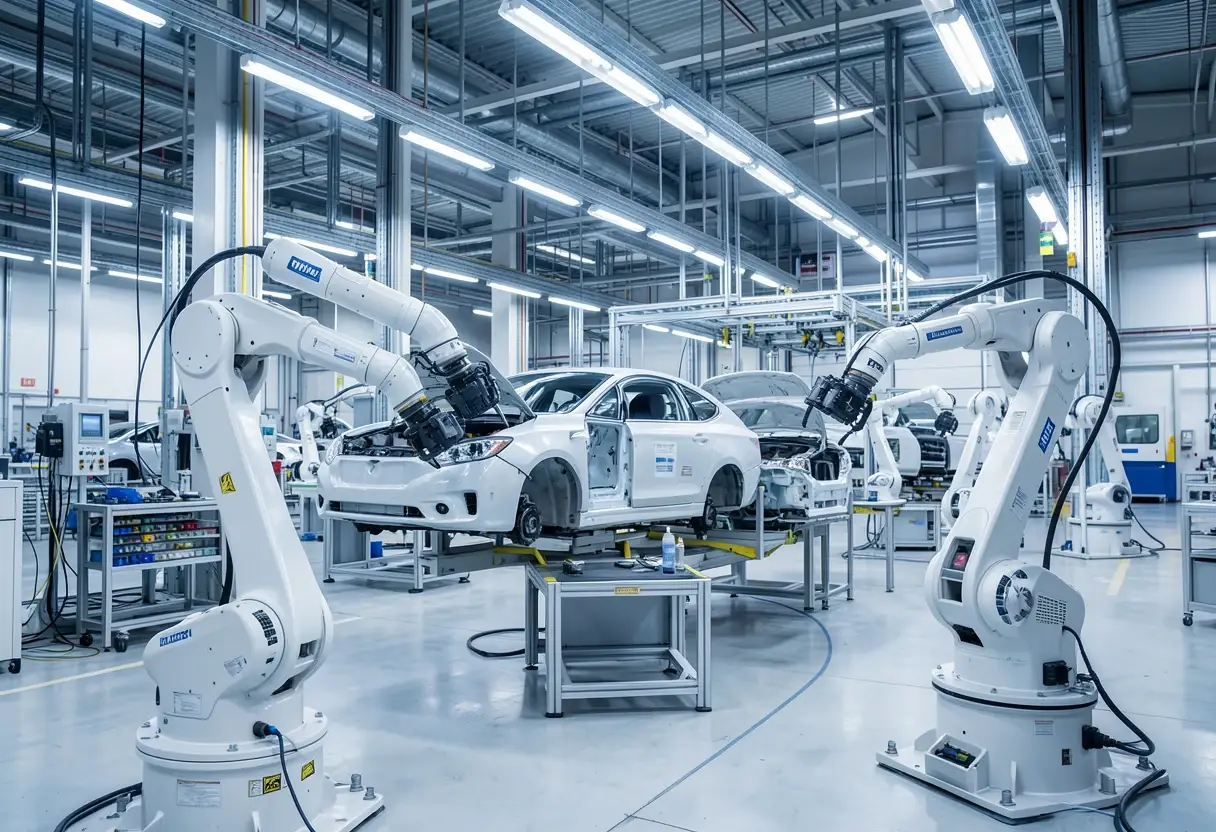
General Motors plans to raise automation use by 20% across its North American factories by 2028, according to Reuters, which cited unnamed sources. GM told Reuters that it uses automation to improve “safety, quality and efficiency,” though the report disclosed no supporting safety, defect-rate or productivity figures.
The automaker presents the programme as a response to higher labour and onshoring (moving production or sourcing back to the US) costs. That rationale has strategic force, but the report discloses no investment total, plant schedule or productivity target.
Why labour costs drive the timetable
The UAW’s 2023 contract gains prompted US automakers to increase automation as they sought to contain manufacturing costs. GM previously estimated that its agreement would add around $575 in labour costs per vehicle, while Ford estimated an additional $900 per vehicle; those are estimates, not reported savings or realised cost reductions.
Automation is expected to feature in the next United Auto Workers (UAW) negotiations with GM, Ford Motor and Stellantis. Their current contracts expire in spring 2028, placing factory technology directly within the coming bargaining round.
How GM is building its robotics capability
GM is developing robots internally and assembling them at its Kokomo, Indiana, plant. The programme includes autonomous mobile robots, systems that transport parts around manufacturing locations, while GM continues to buy robotics equipment from external suppliers as internal development expands.
Last year, GM said it had around 100 roboticists (robotics specialists), AI (artificial intelligence) engineers and hardware specialists working on advanced robotics systems. The combination creates two sourcing channels—internal development and external purchases—but the team’s output and GM’s purchasing volumes remain unquantified.
How suppliers enter the equation
GM asks parts suppliers seeking new contracts to provide automation plans. According to the cited sources, it assesses supplier automation activity through a scorecard, a comparative assessment used in contract decisions, extending the programme beyond GM-owned factories. The source gives no criteria, weighting or savings thresholds, leaving outside readers unable to assess what investment would influence an award.
What does this change for GM’s costs, workers and suppliers?
For GM, automation is a cost-control and contract-negotiation lever, but the evidence still describes an intention rather than a quantified savings programme. The report identifies no factory headcount effects, job classifications or production assumptions, leaving the 2028 labour outcome unresolved.
For suppliers, the scorecard may shape contract awards as bargaining approaches. For workers, automation enters negotiations covering about 50,000 GM factory workers, but neither a jobs guarantee nor a redundancy plan appears in the source; the method and timing of any labour impact remain unstated.
What the financial results show
GM narrowed its 2026 adjusted earnings before interest and taxes (adjusted EBIT) guidance to $14.5bn–$15.5bn from $14bn–$16bn last month. Alongside that forecast update, it approved a new $20bn share repurchase authorisation, meaning permission to buy back shares. Neither disclosure quantifies robotics savings, and the source gives no repurchase timetable.
The third-quarter reporting period ended 30 September 2026. GM reported:
- Revenue of $50.01bn, up 2.9% year on year.
- Net income attributable to stockholders of $3.33bn, against $1.32bn a year earlier.
- Adjusted EBIT of $4.10bn, up 21.6% year on year.
- Operating income of $3.59bn, compared with $1.07bn in the third quarter of 2025.
- Diluted earnings per share (EPS), after allowing for potential share dilution, of $3.73, against $1.35.
The stronger quarter does not establish an automation payoff because the source reports no robotics contribution. It also gives no revised operational assumptions behind the guidance narrowing, preventing a direct link between the technology programme and the forecast.
GM’s strategy combines internal robot development, external equipment purchases and supplier pressure to manage labour exposure ahead of 2028 bargaining. What remains unproven is the scale, cost and timetable of the programme, as well as its effect on work and contracts.
Investors should treat the 20% target as a reported ambition, not a booked financial benefit. A firmer assessment requires deployment milestones, investment figures and measurable productivity gains.
via just-auto.com (Source)
More from Sophie Lindqvist
Show full bio
Correspondent covering money, funding and market shifts around corporate strategy and chief-executive leadership at CEO Frontier.
479 articles
Adjacent sheets
- Toyota Commits Y1tn a Year to Robots and Factory Overhaul
- GM Cuts Hundreds of IT Workers in Corporate Restructuring
- AI can't fill 1.7 million skilled trades openings a year, CEOs say
- C.H. Robinson Credits AI With 60% Productivity Gains Since Late 2022
- Path Robotics Raises $300 Million at $2.45 Billion Valuation