Field report NW-52 / J9 · sheet /expansion
Expansion & MarketsFiled from the territory
Pentagon Picks Seven Laser Systems for December Drone Shoot-Off
The Pentagon selected seven laser systems on November 16 for a December live-fire drone shoot-off at Dugway, with successful performers moving straight to purchase orders.
- Grid
- NW-52 / J9
- Surveyed
- November 19, 2026
- Reading
- 3 min read
- Correspondent
- Olivia Hart
Field notes
- The Pentagon selected seven laser systems on November 16 from 13 technical proposals for a December shoot-off.
- Live-fire testing runs mid-December at Dugway Proving Ground, Utah, and can convert directly into purchase orders.
- In July, the Pentagon committed $86 million to nLIGHT Defense and Lockheed Martin Aculight for laser development.
- An Army laser operationally downed three hostile drones near the U.S. southern border in August.
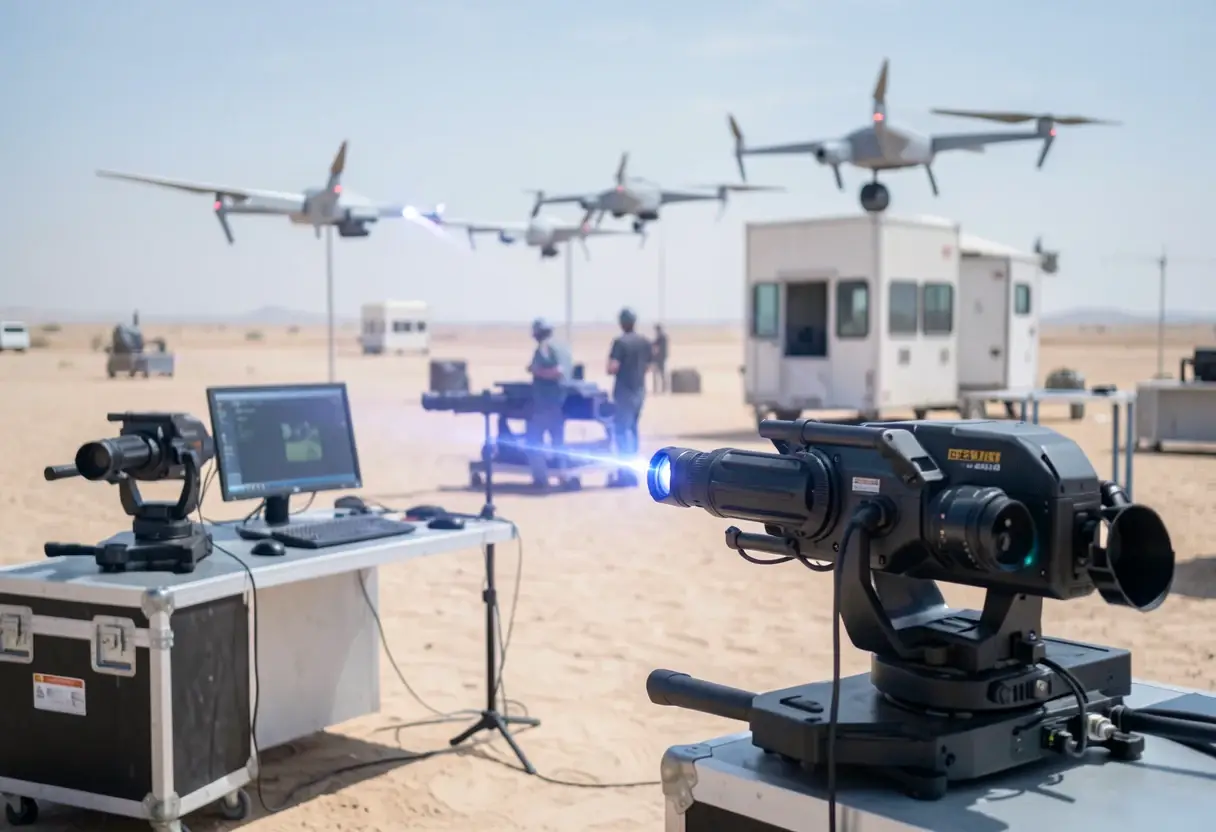
Seven companies will fire high-energy lasers against drone targets at Dugway Proving Ground, Utah, in mid-December — and any system that performs can convert its demonstration into a purchase order almost immediately.
The Department of War announced the selections on November 16 after reviewing 13 technical proposals. The Office of the Secretary of Defense's research and engineering arm and Joint Interagency Task Force 401 picked seven high-energy laser systems for the live-fire evaluation, which could lead directly to military purchases as the Pentagon hunts for cheaper defenses against drone threats.
Who made the cut?
The seven selected systems span established defense primes and smaller specialists:
- Allen Control Systems — BULLFROG HEL
- Aurelius Systems — ARCHIMEDES
- AeroVironment (BlueHalo) — LOCUST X1
- Kord Technologies — FIREFLY
- Lockheed Martin (IPG) — Crossbow
- Thor Dynamics — LASER ARMOR HEL
- Yrikka — TALOS drone-based HEL
Each participant must clear safety certifications and integrate its system with military command-and-control networks before testing begins. The December evaluation will measure how well each laser tracks and defeats representative drone targets.
What does the shoot-off change for contractors?
The decisive feature is procurement speed. Selection for testing does not guarantee a contract, but the Pentagon has structured the event so that success translates into production funding without a traditional acquisition cycle in between.
Army Brig. Gen. Matthew Ross, director of JIATF 401, said: "We're trying to structure the shoot-off in such a way that systems that perform effectively or successfully can immediately result in a purchase order that allows us to start building the production lines to get these systems into the field."
For the vendors, that means the December event functions as both a technical trial and a sales pitch. A strong performance against representative targets could put a small developer on a production line within weeks, while a weak one ends the opportunity at Dugway.
Why lasers instead of missiles?
The economics drive the choice. Inexpensive hostile drones have exposed a cost problem in traditional air defense: interceptor missiles and ammunition must be replaced after every engagement, and each round costs far more than the drone it destroys.
High-energy lasers take a different approach. They use concentrated electromagnetic energy to damage sensors, burn through materials or destroy critical components. According to the U.S. Government Accountability Office, these weapons offer the potential for repeated engagements at relatively low cost.
Lasers need no new projectile for each shot. They draw primarily on electrical power, giving them what the Pentagon calls a "deep magazine" — the ability to keep firing as long as the power supply holds.
The technology carries real constraints, however. Lasers generally engage one target at a time and require a clear line of sight to it. Fog and other poor atmospheric conditions can degrade their effectiveness. Power and cooling requirements also complicate deployment.
Those limits explain the Pentagon's framing: lasers will complement rather than replace missiles, electronic warfare and other counter-drone systems.
How does this fit the broader directed-energy push?
The December competition continues an acceleration that has been building for months. In July, the Pentagon announced $86 million in initial agreements with nLIGHT Defense and Lockheed Martin Aculight to develop systems that defend against drones and cruise missiles.
In August, the Pentagon reported operational use of an Army laser system against three hostile drones near the U.S. southern border — a first indication that directed-energy weapons had moved from test ranges into real engagements on U.S. soil.
The Dugway event pushes the same agenda one step further: fielding laser weapons at scale. Where earlier programs funded development, this competition tests ready systems against realistic targets and ties results directly to production decisions.
For the seven competitors, the path is now simple in outline and unforgiving in practice. Certify safety, plug into command-and-control networks, hit the targets in Utah — or watch a rival take the order.
via dronelife.com (Source)
More from Olivia Hart
Show full bio
News editor covering regulation, policy and their impact on corporate strategy and chief-executive leadership at CEO Frontier.
458 articles
Adjacent sheets
- Pentagon to test seven laser systems against drones in Utah
- Army Opens Manufacturing Rodeo: $3,000 Drone Cap, 400-Aircraft First Run
- Hawaiian Electric Deploys Cyberhawk Drones to Find Grid Faults Before Wildfires Start
- nLIGHT Lands $627M Laser Weapon Deal as Margins Hit Record
- Army Awards $2.5 Million AI Drone Contract to Protect Abrams