Field report N-97 / M5 · sheet /macro
Boardroom MacroFiled from the territory
Nvidia's Huang urges UK, US to deepen AI safety talks with China
Nvidia's Jensen Huang has asked Washington and London to step up direct dialogue with Chinese AI researchers, naming Britain as a possible convener but offering no agenda, timetable, or named counterpart.
- Grid
- N-97 / M5
- Surveyed
- October 15, 2026
- Reading
- 3 min read
- Correspondent
- Sophie Lindqvist
Field notes
- Jensen Huang, CEO of Nvidia, said the US and UK should intensify dialogue with Chinese AI researchers
- Huang named the UK as a possible convener for the exchanges
- His proposal names no Chinese counterpart, agenda, or timetable
- Nvidia is the dominant global supplier of AI accelerators
- US export controls restrict sales of Nvidia's most advanced AI chips to Chinese buyers
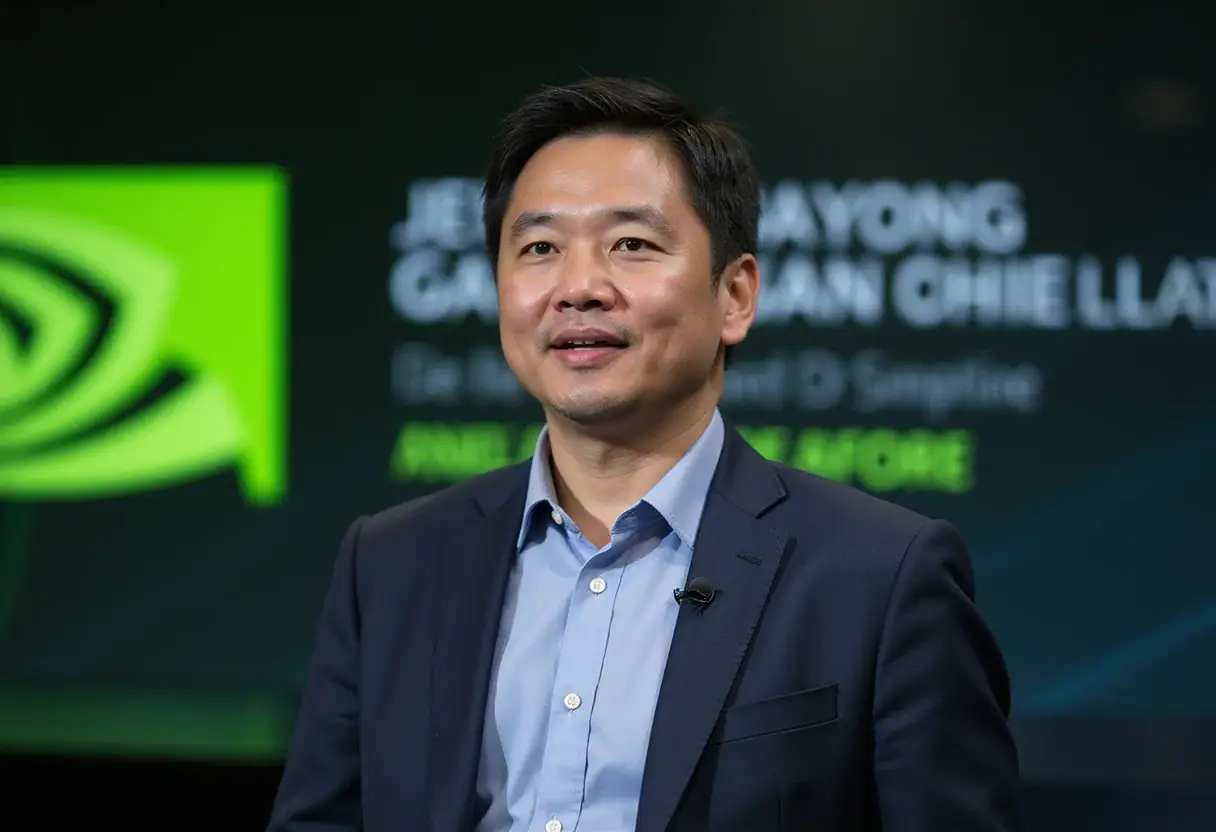
Nvidia Chief Executive Jensen Huang has called on the United States and the United Kingdom to intensify direct dialogue with Chinese artificial-intelligence researchers, naming Britain as a possible convener for the exchanges.
"The U.S. and U.K. should step up dialogue with Chinese AI researchers," Huang said in remarks carried this week, casting the request as a matter of AI safety rather than market share.
The intervention matters because Nvidia sits at the base of the global AI hardware stack — the layered chain of processors, networking and software on which AI systems are built. Any US-China rift on chips reshapes the firm's order book.
What did Huang actually propose?
Huang's statement is brief, but two claims carry weight. The first is that AI safety is a shared problem no single country can manage unilaterally. The second is that London — not Washington or Beijing — should host the conversation.
Nvidia is the dominant supplier of AI accelerators, the specialised processors that train and run large language models. That position makes Huang's framing unusually consequential for any future regime.
The proposal, however, lacks three items policymakers usually demand before convening:
- No named Chinese counterpart laboratory or ministry
- No agenda beyond the word "dialogue"
- No timetable for any meeting
Why now — and what is missing?
Huang has reasons to speak that go beyond diplomacy. Nvidia's flagship AI chips remain subject to US licensing rules that limit sales to Chinese buyers, and the firm has designed downgraded variants for that market.
Speaking about safety gives the chief executive room to keep a seat at the table without committing Nvidia on the export-control question (the licensing regime that restricts which advanced semiconductors may be shipped to China).
His remarks also omit three specifics any host government would press for:
- Whether a UK-hosted track would carry technical access — including to model weights, the numerical parameters that define how an AI system behaves — that current US rules deny Chinese firms
- Whether Britain has signalled willingness to host a third AI safety summit
- Whether Beijing has reciprocated the framing in any public statement
The omissions are strategic. By speaking about safety rather than semiconductors, Huang avoids any commitment that would put him at odds with the US Commerce Department. By pitching the UK as host, he taps a country with limited chip-export leverage but with a recent record of convening major AI forums.
What does this change for chip makers and policymakers?
For Nvidia and its investors, the change is rhetorical rather than regulatory. A CEO's call rarely alters licensing decisions taken in Washington.
It does, however, keep Nvidia inside the policy conversation at a moment when Chinese rivals — including Huawei's Ascend line and Cambricon — are scaling domestic alternatives.
For the UK government, the practical question is whether London has both the diplomatic standing and the technical credibility to host. Britain is home to DeepMind and to Anthropic's European base, yet it holds limited export-control leverage. That mismatch sits unresolved in Huang's pitch.
For Chinese AI researchers, the most concrete test will be whether any dialogue includes access to restricted hardware, model evaluations (independent tests that probe AI systems for dangerous capabilities) or shared benchmarks. Without that, the proposal risks becoming a talking shop.
A caveat follows every promise
Huang's appeal fits a familiar template: industry leaders ask governments to convene, governments gesture toward summits, and concrete obligations stay thin.
Until London publishes a host plan, until Washington clarifies whether export licences form part of the bargain, and until Beijing names a counterpart, the proposal remains a CEO's preferred posture rather than a policy shift.
via Quartz (Source)
More from Sophie Lindqvist
Show full bio
Correspondent covering money, funding and market shifts around corporate strategy and chief-executive leadership at CEO Frontier.
86 articles
Adjacent sheets
- Jensen Huang: AI ROI demands are like forcing a child to plan a hobby
- U.S. Sanctions Five Chinese Firms Tied to Stolen Google AI Secrets
- Naver Signs $9 Billion AI Factory Deal With Brookfield
- OpenAI's CFO Warns Firms on Cybersecurity Risks of Chinese AI Models
- TikTok CEO and Microsoft Executive Warn AI Hype Outruns Reality