Field report W-33 / L1 · sheet /expansion
Expansion & MarketsFiled from the territory
Nigeria's President Courts Health-Sector Investors to Build Homegrown Industry
President Tinubu says N24 billion in waivers and ten new factories will turn Nigerian health spending into domestic industry, jobs and cheaper medicines.
- Grid
- W-33 / L1
- Surveyed
- November 17, 2026
- Reading
- 3 min read
- Correspondent
- Elena Vasquez
Field notes
- Over N24 billion in tax and tariff waivers approved for 75 manufacturers between January 2025 and June 2026.
- PVAC was established in October 2023; NHSRII launched December 2023.
- Ten priority health-product factories being established, six in 2026.
- Net producers Vestergaard and Harvestfield to make over 10 million nets a year and employ 600+ people.
- Executive Order providing sector tax relief signed June 2024.
Nigeria approved more than N24 billion in tax and tariff waivers for 75 local healthcare manufacturers between January 2025 and June 2026, according to President Bola Tinubu, who set out his case for building a domestic healthcare economy in a statement outlining the work of the Presidential Initiative for Unlocking the Healthcare Value Chain (PVAC).
Tinubu established PVAC in October 2023 to cut Nigeria's dependence on imported medicines and medical equipment and to capture more of the production, employment and specialist services financed by Nigerian health spending. "A country with our demographic strength should be securing a greater share of the production, employment and specialist services supported by what our people spend on their health," the President said.
The initiative sits within the Nigeria Health Sector Renewal Investment Initiative (NHSRII), launched in December 2023 to advance the health commitments of the Renewed Hope Agenda. Under a related compact, the Federal Government, the 36 states and development partners committed to a common reform programme spanning governance, health services, domestic production and emergency preparedness. Tinubu framed industrial policy and clinical investment as one programme, arguing that a presidential structure lets decisions on health, finance and industry move together — coordination he called essential for capital-intensive projects that need years to reach commercial scale.
What has the fiscal relief delivered?
The Executive Order signed in June 2024 provided tax and tariff relief on specified machinery, equipment and inputs for local healthcare manufacturing. The waivers approved since — N24 billion across 75 manufacturers in 18 months — are intended to make expansion viable and carry through to the price and availability of essential products.
The production base is responding, the President said:
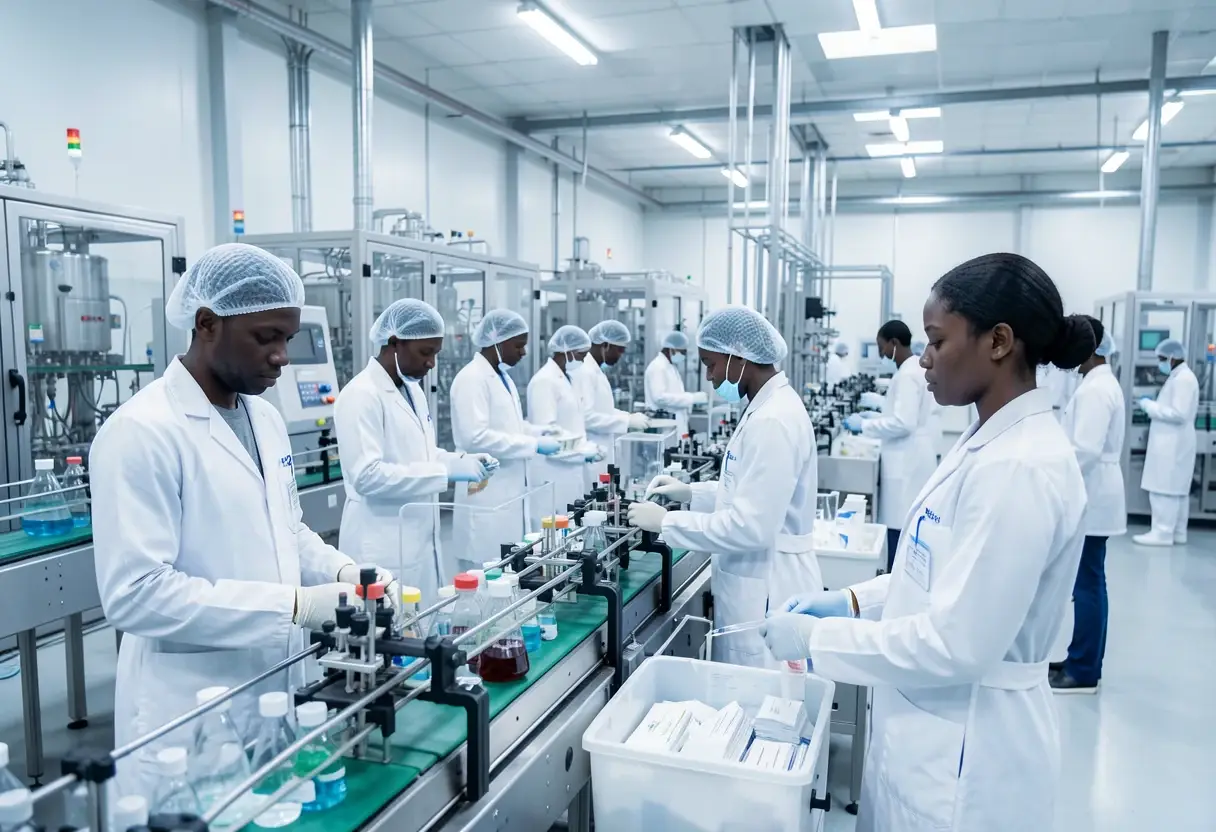
- Ten factories producing priority health products are being established, six of them in 2026 alone.
- Output ranges across medicines, diagnostic tests, medical oxygen and mosquito nets.
- Each plant is meant to anchor further skills, suppliers and investment.
Can local production reach scale?
The mosquito-net sector offers the clearest test. Vestergaard, under a 2024 agreement with PVAC, began operations at Health Textiles Nigeria in September 2026. Harvestfield, an indigenous firm, is producing dual-ingredient nets. At full scale the two companies will produce more than ten million nets annually and employ more than 600 people, with Nigerian workers receiving further technical training. For a country with a heavy malaria burden, Tinubu said, the benefit must reach families through wider access to effective protection.
Diagnostics follow the same logic. Codix Bio has signed an agreement with the Medicines Patent Pool, supported by the World Health Organization, to receive technology transfer from SD Biosensor and manufacture rapid diagnostic tests in Nigeria. NASENI-Troment is producing diagnostic kits locally with what the statement called world-class technology.
How does demand get organised?
Tinubu acknowledged that Nigerians will judge the reforms by the care they can obtain and afford today. New capacity takes time to reach full effect, domestic manufacturers still face unresolved costs, and local production must meet demanding standards of quality and competitiveness, he conceded.
The government's answer on the demand side is Medipool, Nigeria's first nationally approved group purchasing organisation, established to pool demand for quality medicines and health commodities, negotiate better prices and provide a more dependable market for local manufacturers. As primary care expands through the Basic Health Care Provision Fund and health insurance coverage widens, better purchasing arrangements are meant to convert growing public demand into predictable orders while stretching public funds further.
The President also targeted outbound medical travel. Investments in advanced diagnostics, cancer care and other specialist services can retain healthcare expenditure in Nigeria, he said, sparing families the cost of treatment abroad and long separation. Exchange-rate swings that put imported essential medicines beyond a household's reach reinforce the case for local supply, he added.
The next stage, Tinubu said, requires sustained attention to financing, reliable demand and the practical conditions for enterprises. He directed the Coordinating Minister of Health and Social Welfare to carry the work forward with the relevant institutions and private partners. Announced investments must progress into production, and production must reach the facilities where Nigerians receive care.
via leadership.ng (Source)
More from Elena Vasquez
Show full bio
Staff writer covering companies, deals and strategy in corporate strategy and chief-executive leadership at CEO Frontier.
486 articles
Adjacent sheets
- Nigeria Grants Pharma Manufacturers N24bn in Tax Waivers
- Barbados $32m Medicine Plant Advances; 2029 Still Conditional
- Makinde Camp Demands Accounting of ₦11.2 Trillion Oil-Backed Loans
- Nigeria's New National Care Policy Targets $9.3 Billion GDP
- UK Backs Nigeria's $750m Pension-Backed Infrastructure Fund